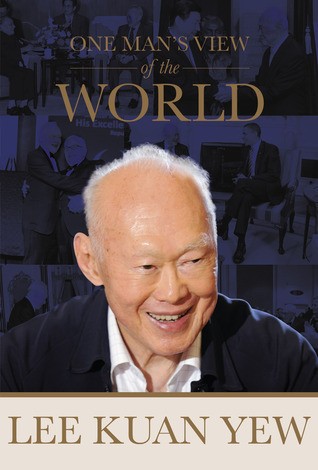
One Man's View of the World
Lee Kuan Yew
Reading Notes
Lee Kuan Yew does not deal in wishful thinking. That is the first thing you notice reading this book. Every assessment — of China's trajectory, America's staying power, India's structural handicaps, Europe's slow drift into irrelevance — is delivered with a clarity that borders on brutal. He does not hedge, does not soften. He simply tells you how he thinks the world works and why. For someone like me who spends time in MUN committees watching delegates wrap realpolitik in the language of human rights and multilateral cooperation, LKY's directness is a kind of cold shower. He strips away the diplomatic veneer and asks: what does this country actually want, what resources does it have, and what will it do when no one is watching?
What makes the book extraordinary is how well his predictions have held up. Writing in 2013, he saw that China would not liberalize politically as it grew richer — that the Party would tighten, not loosen, its grip. He saw that India's democracy, for all its virtues, would remain hamstrung by bureaucratic inertia and caste fragmentation. He saw that Europe would struggle to act as a unified strategic player. A decade later, reading these chapters feels less like forecasting and more like a report filed from the future. His framework is simple and old-fashioned: demographics, geography, culture, leadership quality. No grand theory. Just pattern recognition honed over fifty years of governing a city-state that had no margin for error. That small-state survival instinct — the idea that you cannot afford illusions because the world will not give you a second chance — runs through every page.
LKY reshaped how I think about the tension between realism and idealism that comes up constantly in MUN and in my coursework. Before this book, I treated realism as one lens among many — useful but incomplete. After reading it, I started to see realism not as a theory but as a discipline: the habit of looking at what is before deciding what ought to be. That does not mean abandoning ideals. It means stress-testing them against the constraints of power, culture, and geography. LKY never governed a superpower, but his thinking about governance efficiency — meritocracy, long-term planning, zero tolerance for corruption — offers a model that is hard to dismiss, even if you question the democratic tradeoffs Singapore made. This book did not make me a cynic. It made me a sharper reader of the world.
Key Takeaways
- → Small states survive by seeing the world as it is, not as they wish it to be — LKY's pragmatism is not cynicism but a survival strategy with no room for self-deception.
- → China's rise will be defined by the tension between its civilizational confidence and the structural limits of a system that concentrates decision-making at the top.
- → Governance quality matters more than regime type — democracies can fail and authoritarian states can deliver, and pretending otherwise is intellectual laziness.
- → In international relations, the gap between what leaders say and what they do is where the real analysis begins — realism is not a theory, it is a discipline of attention.
“I am not interested in being politically correct. I am interested in being correct.”
— Lee Kuan Yew